3 Hot Technologies that Are Changing the World
In the last 100 years, we have seen the invention of the telephone, the automobile, the computer, the cell phone, and the incandescent light bulb. The past century has been marked by the likes of Henry Ford, Albert Einstein, and Thomas Edison.
However, I believe the next 100 years will be even more exciting than the last. As we look ahead to the future, there are three technologies that excite me the most. One is the explosion of user-generated content on the Web and the incredible amount of collaboration that is currently taking place around the Internet. The second is opencourseware and the open-source movement. Open-source is making a dramatic impact on the way we learn, the software we use, and the way we do business.
The third and final technology that is set to make a huge impact on education is augmented reality, a computer generated environment that allows students to learn at a highly accelerated pace.
Without further ado, I would like to present to you, the greatest innovator of the next century:
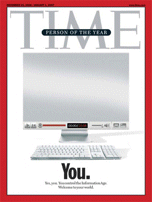
The greatest innovator of the next century is You. Yes, I said YOU.
The explosive growth in user-generated media caused Time magazine to name “You” as “Person of the Year” for 2006.
We are experiencing a time in Internet history marked by collaboration and community. The world has been linked together through the pages of MySpace, the collective knowledge of Wikipedia, and the home-grown videos of YouTube.
Lev Grossman of Time magazine wrote, “For seizing the reins of the global media, for founding and framing the new digital democracy, for working for nothing and beating the pros at their own game, Time’s Person of the Year for 2006 is you,”.
The Internet is giving the power to the people. As said by Grossman, “It’s a tool for bringing together the small contributions of millions of people and making them matter.”
Our world is now tapped into a global intelligence stream, making us more productive and efficient than ever.
At last count, there were over 70 million blogs.
Many of these blogs are rising to the top and becoming respectable information sources among the traditional media outlets.
Individuals are gaining a new-found power from the Web. We are no longer just consumers, but rather a collective group of producers.
With a single Internet connection, we can spread our ideas around the world. Every person can now be an independent publisher on the Internet, creating their own news reports, podcasts, blogs, online videos and even their own radio shows. The web has become host to a world of user-generated content.
In this day and time, every Internet-connected computer is its own publishing press. If you have something to say, the Internet allows you to digitize it and send it out to the world. (no journalism degree required)
The collective blogs, videos, and social networks have shifted the power from big media networks to independent publishers.
The Internet is allowing us to upload news and information on the fly. Even the daily newspaper is highly outdated in comparison to the Internet.
“Journalists once had the exclusive province of taking people to places they’d never been. But now a mother in Baghdad with a videophone can let you see a roadside bombing or a patron in a nightclub can show you a racist rant by a famous comedian,”
The paparazzi now face stiff competition from every citizen journalist with a camera phone.
The second technology that is changing the world at a rapid pace is Opencourseware and the Open-source Movement.
In 1991, Linus Torvalds wrote a new operating system called Linux. Linus wrote the new operating system from scratch along with some assistance from a loosely-knit team of hackers across the Net.
Torvalds uploaded his Linux operating system to the Internet and allowed everyone to download it for free. Linux quickly became Microsoft’s number-one competitor.
Their success story proved that you don’t need a paid team of programmers and a structured heiarchy to create software that rivals the likes of Microsoft.
Torvalds combined forces with an underground of geeks and hackers to create the ground-breaking Linux operating system that is now transforming the world of open-source software. Linus did all of this from his college dorm room at the young age of 21.
Today, Linux powers everything from supercomputers to mobile phones around the world. Linux prompted the open-source movement, in which software is created in a shared environment rather than being developed in a major business setting with numerous patents under lock and key.
Communities of geeks are now combining their intellectual prowess to create software that competes with the big boys. The only difference is that these programmers are working to create software because they have a passion for programming and want to see their contributions make a difference. They’re not in it for the paycheck.
A number of highly competitive open-source projects soon followed after the Linux outbreak. Since that time, we have seen a number of other success stories, including Firefox, OpenOffice, and Wikipedia.
Open-source software is now revolutionizing business, transforming the classroom, and enabling a higher level of education across the planet.
Just take a look at MIT OpenCourseware to see how the open-source movement is transforming education. One of the most respected schools in the nation has decided to give open access to class syllabi, lecture notes, sample tests, reading lists, slide presentations and even a selection of video lectures.
MIT has unlocked the vault to higher education. You can now listen to the lectures and read all of the class handouts just as if you were in the very classrooms of MIT.
Some of the most advanced and exclusive courses are at your finger tips. For those who are self-learners, MIT opencourseware is a goldmine. The courses range from engineering and mathematics to economics and business. You can check it out at http://ocw.mit.edu/index.html
Best of all, there are a number of Universities that are planning to follow in their footsteps, opening education opportunities in every part of the world.
The amount of knowledge now available on the Internet is simply daunting. Anyone with an Internet connection and a desire to learn can log on and master everything from photography to web design.
However, much of our education is still 50 years out-of-date. Think about it, how much has education really changed in the past 50 years? We’re still using pencils. We still focus on rote memorization. We’re still using paper, despite the fact that most workplaces have created paperless offices.
Drastic changes need to be made in education. One of the technologies that could bring us up-to-date is known as augmented reality, a technology that could radically change the way we learn.
Superlearning systems such as augmented reality allows people to rapidly accelerate the learning process by engaging them in a three-dimensional, computer-generated, learning environment. Researchers have found that the human brain learns best through multi-sensory association and not the rote memorization techniques that are so often used in school today.
This means that a child learns best when they are engaged in a topic through a number of different senses, including sight, sound, emotions, touch, and even smell and taste.
For example, if you are learning about computers, it is one thing to study about them in a book. It is quite another to take one apart and physically touch and learn about each of the parts within. When you engage the senses, your learning capability is magnified exponentially.
How can we apply this type of multi-sensory learning to all of our learning experiences? This can be achieved through augmented reality.
Augmented reality can provide us with a multi-sensory, high-immersion learning experience made possible through the use of a headset.
With augmented reality systems, we can provide the imagery, sounds, and even tactile feedback that accelerates the learning experience.
Just imagine how History class could be transformed through the use of augmented realtiy systems. Instead of just talking about history, students could hold virtual conversation with historical figures, walk-through the battle-scenes of every major battle, fly over the Great Wall of China, or stand in the audience as Martin Luther King Jr. gives his famous “I have a Dream” speech.
Imagine being able to experience a piece of history by walking through it and seeing each historical figure standing in the room around you. Imagine exploring the human body as if you were a single cell, traveling through the body. All of this is made possible with augmented reality.
Once programmed, these augmented reality systems could guide students through an umlimited number of educational exercises that are highly engaging, self-paced, fun, and highly interactive.
These are just a few of the technologies that are changing the way we live. I encourage you to be on the lookout for emerging technologies that empower people to live life at higher levels of consciousness.
If you enjoyed this post then make sure you subscribe to my RSS feed.
Additional Resources:
Time’s Person of the Year: You
‘Augmented reality’: the educational component
The Top Ten Technologies: #3 Augmented Reality
Charlie Rose Interview with Linus Torvalds